-
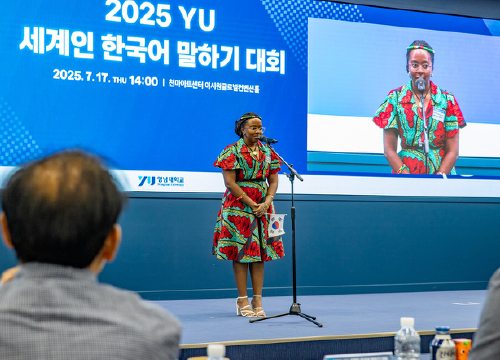
Participants from 20 Countries Share Diverse Korean Stories of Communication and Inspiration Presentations Highlight K-Brands, Local Communities, and Korean Culture 15 Winners Including the Grand Prize… “Korean is a Language that Connects the World” [July 21, 2025] Yeungnam University (President CHOI Oe-chool) hosted the 2025 YU World Korean Speech Contest on July 17 at the Lee Si-won Global Convention Hall in Cheonma Art Center. Held in celebration of the university’s 78th anniversary, the contest brought together foreign high school and university (including graduate school) students to showcase their Korean language skills and engage in global cultural exchange through Korean language and culture. This year’s competition attracted more than 70 applicants from 20 countries, including China, Vietnam, Sierra Leone, Malawi, Ghana, and Mexico. After document screening and recorded video evaluations, 15 finalists were selected to present their unique Korean-language stories and experiences. Presentation topics covered a wide range of themes connecting Korea and the world, including: ▲ My Korean Study Abroad Story ▲ Global Common Challenges and Ideas for Solutions ▲ The Value and Significance of K-Brands ▲ Understanding K-POP and Korean Culture ▲ Korea’s Development Experience ▲ Global Citizenship and Korean Culture The final round was conducted in a hybrid format, combining on-site and online participation. Overseas university contestants joined the finals via live online presentations, and the entire event was streamed live on YouTube, delivering the passion and enthusiasm for the Korean language to viewers in real time. Contestants impressed the audience with their fluent Korean and outstanding presentation skills. Awards were presented for Grand Prize, Excellence Award, Encouragement Award, and Best Presentation Award to participants who excelled in creativity, delivery, and expressiveness. All awardees also received prize money. The Grand Prize (1st place) went to Akkhasang Thanyarat from Thailand, who moved the audience deeply with an authentic and heartfelt presentation on the theme My Korean Study Abroad Story. In her acceptance speech, she said, “When I first came to Yeungnam University, everything felt unfamiliar and challenging, but learning Korean here allowed me to connect more closely with people. Preparing for this contest helped me improve my Korean skills, and I’m so happy to have created another joyful memory.” In his congratulatory remarks, YU President CHOI Oe-chool stated, “This contest goes beyond simply competing in Korean language skills. It is a space to share and connect over Korea’s development experience and cultural values. I hope participants will broaden their understanding of Korean language and culture, and reflect on the direction humanity should take to live together.” He added, “YU will continue to actively support foreign students’ growth and their meaningful ties with Korea through diverse educational programs. We will further develop YU into a university where people from around the world can come together to share wisdom and nurture their dreams.” Meanwhile, YU has been holding the Korean speech contest annually for foreign students, along with Korean cultural experience programs and community engagement activities, as part of its ongoing efforts to promote communication, settlement, and the cultivation of global talent among international students.
- PR team
- 2025. 08. 13
- 2025. 07. 21
- 20294
-
Korea, Now a Developed Nation, Gives Back to Ethiopia by Nurturing Saemaul Leaders Sharing Korea’s Development Experience… Werabe University Students and Faculty Visit YU Saemaul Movement, Digital Education, and Cultural Experiences Lay Foundation for Strategic International Development Partnership [July 25, 2025] A delegation of students and faculty from Werabe University, a national university in Ethiopia, visited Yeungnam University (President CHOI Oe-chool) to learn about Korea’s development experience and the field of Saemaul Studies.This invitation is drawing attention as a practical example of international cooperation rooted in the spirit of “gratitude” toward Ethiopia, which aided Korea during the Korean War, at a time when Korea has grown into a developed nation and is now contributing to the global community. The Institute for International Development Cooperation (IIDC) at YU hosted the 2025 Werabe University Training Program from July 20 to 25.The program was designed to strengthen mutual understanding and bonds through academic and cultural exchanges and hands-on learning, while building a strategic partnership to serve as the foundation for future international development cooperation projects. Werabe University, located in southern Ethiopia, has been expanding joint initiatives in Saemaul Studies, forestry, agricultural development, and digital education since signing an MOU with YU in 2022.In particular, Werabe University has been working to incorporate the Saemaul Movement into its community development strategies. With this visit, the university plans to establish a new Department of Saemaul Forestry in September, enrolling 20 freshmen, thereby solidifying bilateral cooperation in rural development and Saemaul Studies education. The visiting delegation consisted of nine members, including the Chief of Staff to the University President, Special Advisor to the Vice President for Academic Affairs, Dean of Student Affairs, and Director of the E-Learning Center, along with five students from the Department of Computer Science and the Department of Forestry.Their program at YU included attending classes at the Park Chung Hee School of Policy and Saemaul (PSPS), touring the university museum, science library, and Smart Education Center, and participating in various educational activities. The group also visited key sites such as the birthplace of the Saemaul Movement at the Gumi Saemaul Foundation, the Chilgok Patriots & Peace Memorial, and POSCO to study Korea’s history and development experience. Additionally, they experienced Korean nature and culture through activities such as exploring Gampo Beach, visiting a traditional market, and touring the Daegu Kansong Art Museum. Meanwhile, YU’s Department of Computer Science and Werabe University’s Department of Computer Science were jointly selected for the 2025 Ministry of Education Global Education Support Project. From May 2025 to January 2026, they are conducting the “EduTech Bridge Cooperation Project for Strengthening SW Education Capacity and Digital Vocational Training at Werabe University.” As part of this effort, the Korea–Ethiopia SW EduTech Forum was also held during the training program. The forum aimed to promote SW education to foster digital talent and upgrade the industrial base in Ethiopia’s Silte Zone. It served as a platform for sharing Korea’s advanced digital education models and EduTech technologies, and for building a cooperative education model between the two nations. The event is being hailed as a strategic starting point for establishing a sustainable Korea–Ethiopia digital education cooperation system. President CHOI Oe-chool of YU stated, “Korea was once a nation that received help from the international community, but it has now grown into a developed country that shares its Saemaul development experience and growth model with the world. In particular, offering education and cooperation to Ethiopia, which shed blood to help us during the Korean War, is the most meaningful act of gratitude Korea can give.” He continued, “Although Korea’s population and land area are less than 1% of the world’s total, we achieved remarkable growth through the leadership of our people and leaders. That experience has become a valuable asset in addressing common challenges of humanity. Sharing it with the international community, especially developing nations, is Korea’s responsibility.” He added,“YU will continue to work with Ethiopia and other African countries, nurturing global talent in Saemaul Studies to help solve Ethiopia’s challenges, contribute to humanity’s shared prosperity, and fulfill the university’s role in serving the international community.” To date, YU’s IIDC has provided Saemaul development training programs to over 3,400 public officials and community leaders from 50 countries, contributing to increased farm income and strengthened community capacity. These programs are recognized as a practical cooperation model with developing countries.
- PR team
- 2025. 08. 13
- 2025. 07. 25
- 20299
-
Sharing Regional Revitalization Models of Both Countries… Expanding Student-Centered Exchange Programs On-Site Exploration of Regional Revitalization and Cultural Content Utilization in Niigata Prefecture YU Joins MOE’s Digital Consortium for Humanities and Social Science Convergence Talent Development [July 25, 2025] The Humanities and Social Science Digital Convergence Talent Development Project Group at Yeungnam University (President CHOI Oe-chool) has signed an MOU with Japan’s NSG Group, strengthening the foundation for international cooperation in the humanities and social sciences. The signing ceremony was held on July 19 at the banquet hall on the 5th floor of Hotel Italiaken in Niigata, Japan. Under this agreement, the YU Project Group, led by Director NO Sang-rae, and NSG Group’s International Promotion Office will expand the scope of collaboration through regular exchanges and joint programs aimed at regional revitalization. Headquartered in Niigata Prefecture, NSG Group is a leading enterprise in the education sector, operating 101 corporate entities. Guided by its policy of “regional revitalization through business creation,” the group has been repurposing vacant commercial buildings and land to establish vocational colleges, while also running a total of four universities and 34 vocational schools in Niigata and Fukushima Prefectures. YU’s Project Group annually selects exemplary sites of regional revitalization and cultural content development, partnering with local institutions and companies to conduct a Regional Revitalization Global Camp.In 2023, the group visited Sabae City in Fukui Prefecture, Japan, and the Sabae SDGs Promotion Center to hold discussions on regional revitalization. In 2024, the second year of the program, the team carried out a global exchange initiative with Shaanxi Normal University in Xi’an, China. This year’s program included not only YU faculty and students but also students from four universities—Korea University, Sunchon National University, Sookmyung Women’s University, and Chungnam National University—that are part of the Digital Consortium for Humanities and Social Science Convergence Talent Development. Participants had the opportunity to directly observe and experience a range of educational projects led by NSG Group and to explore practical, field-based models for regional revitalization. Yukihiro Sato, Deputy Director of NSG Group’s International Promotion Office, stated, “Japan and Korea share the common challenge of regional depopulation. This collaboration provides a valuable platform for mutual learning, and we look forward to sustained exchanges and cooperation with YU.” NO Sang-rae, Director of the Project Group and Professor in YU’s Department of Korean Language & Literature, commented, “Thanks to the active support of the Consulate General of the Republic of Korea in Niigata and NSG Group, we were able to run this program successfully. We discovered numerous examples that can be applied to Korea’s regional revitalization policies, and we aim to strengthen our cooperation framework to further enhance students’ competencies.” Meanwhile, YU’s Humanities and Social Science Digital Convergence Talent Development Project Group was selected in 2023 for the Ministry of Education’s Humanities and Social Science Convergence Talent Development Project. The group will receive approximately KRW 1.5 billion in national funding until February 2026 to operate diverse extracurricular programs, domestic and overseas study tours, and symposiums, all aimed at fostering convergence talent with strong digital competencies.
- PR team
- 2025. 08. 13
- 2025. 07. 25
- 20111
-
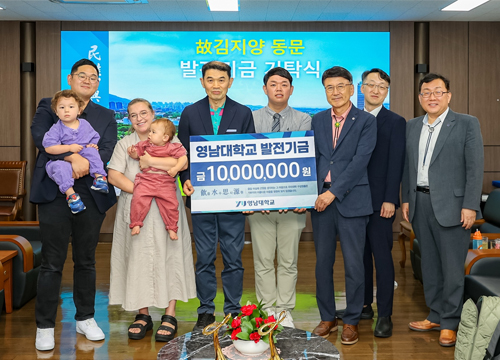
Class of ’83 Medicine Alumna KIM Ji-yang Expressed Wish for Alma Mater and Juniors to Benefit from Her Legacy Husband, Chief LEE Sang-mok, Delivers Development Fund to YU in Accordance with Late Alumna’s Will Honoring Her Professional Excellence and Spirit of Giving… Fund to Support Medical Talent Development at YU [August 4, 2025] 사진: <가운데 왼쪽부터 이상목 과장, 장남 이기하 씨, 최외출 영남대 총장> Even after her passing, the late Kim Ji-yang, a 1983 alumna of Yeungnam University’s (YU) College of Medicine, continues to extend her warmth and generosity to future generations. Honoring her wishes, her husband Lee Sang-mok, Chief of the Orthopedic Surgery Department at Daegu Catholic University Chilgok Catholic Hospital, has donated KRW 10 million to YU’s development fund. A donation ceremony was held on July 25 at the YU Main Administration Building, attended by the donor’s husband and two sons, along with YU President CHOI Oe-chool, Vice President for External Affairs LEE Kyung-soo, Associate Dean of the College of Medicine DO Kyung-oh, Director of External Affairs YOON Jeong-hyeon, and other university officials. They gathered to express deep gratitude and to honor the noble spirit of the late alumna. After graduating from YU’s College of Medicine, KIM completed her radiology residency at Sungkyunkwan University’s Changwon Samsung Hospital and pursued an abdominal radiology fellowship at Seoul National University Hospital. She later served as a faculty member at Seoul National University Hospital’s Gangnam Center. Her career took her to the University of Louisville in the U.S. for research and subsequently to the University of Iowa College of Medicine as a clinical faculty member—becoming the first YU medical alumna to hold a full-time clinical faculty appointment at a U.S. medical school, a distinction of great significance. KIM was an active member of the Korean Society of Radiology, the Korean Society of Thoracic Radiology, and the Korean Society of Magnetic Resonance in Medicine, among others. She published extensively in renowned domestic and international journals and authored scholarly books, making substantial contributions to the advancement of radiology. Many of her works remain highly cited to this day, continuing to exert academic influence. Even during her battle with cancer, KIM repeatedly expressed her desire to “give back the education I received” and to support her alma mater and its students. Carrying out her wish, her husband donated the fund to YU’s College of Medicine. The contribution will be used to nurture outstanding talent, as well as to train dedicated medical professionals committed to improving human health and serving communities in need. “My wife always cared deeply for her patients and students, devoting herself wholeheartedly to research and education,” said Lee. “She often said she wanted to help her juniors and hoped they would grow into world-class physicians, not limited to Korea. I believe this gift will serve as a foundation for them to pursue greater dreams.” President CHOI expressed deep appreciation: “We are sincerely grateful for the noble will of the late alumna KIM Ji-yang, who always kept her alma mater and juniors in her heart. We also pay our respects to the bereaved family for their strength in fulfilling her wish despite their grief. Her academic passion and warm spirit will inspire our medical students to save lives and contribute to humanity.”
- PR team
- 2025. 08. 13
- 2025. 08. 04
- 20103
-
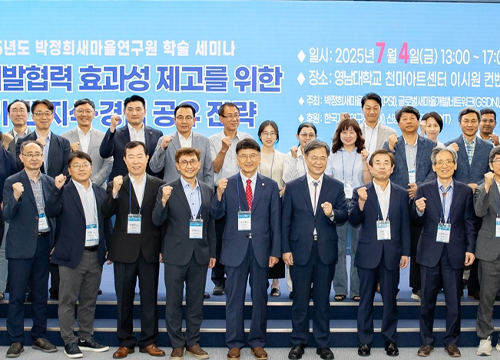
Seminar held under the theme, “Strategies for Sharing Knowledge and Experience Across Countries to Enhance the Effectiveness of International Development Cooperation” Experts from academia and public institutions gather to discuss Saemaul Undong and international development Exploring the academic value of Saemaul Undong and strategies for global cooperation with developing countries for shared prosperity [July 9, 2025] The Park Chung Hee School of Policy and Saemaul (PSPS) at Yeungnam University (YU) hosted an academic seminar titled “Strategies for Sharing Knowledge and Experience Between Nations to Enhance the Effectiveness of International Development Cooperation” on July 4 at the Lee Si-won Global Convention Hall in Cheonma Art Center. The event was jointly organized by PSPS (Dean LEE Jeong-ju), the Global Saemaul Development Network (GSDN), the Institute for International Development Cooperation (IIDC), and the Global Development Foundation (GDF), with support from the Korea Development Institute (KDI) and the Korea Credit Guarantee Fund (KODIT). The seminar brought together more than 100 participants, including scholars, officials from public institutions and state-owned enterprises, graduate students, and undergraduates specializing in Saemaul development and international development cooperation. <Dean LEE Jeong-ju of PSPS delivers opening remarks.> The seminar aimed to shed new light on the experience and academic value of Korea’s unique regional development policy, Saemaul Undong, and to discuss various strategies and policy alternatives for enhancing the effectiveness of international development cooperation. It also explored the potential of expanding Saemaul Undong beyond community development into a global development cooperation model.Participants engaged in in-depth discussions on the distinctive characteristics and policy implications of the Saemaul Undong in improving the effectiveness of international development cooperation. They also explored strategic tasks for co-prosperity with the international community. The attendees shared diverse opinions on how Korea’s development experience can be applied in global development cooperation fields and pledged to expand both academic and practical exchange. <President CHOI Oe-chool of YU delivers a welcome speech at the seminar hosted by PSPS.> In his welcome speech, President CHOI Oe-chool stated, “Based on the values of diligence, self-help, and cooperation emphasized by President Park Chung Hee, YU has been actively promoting the academic advancement and globalization of the Saemaul Undong.” He added, “This seminar serves as a meaningful platform to explore the distinctiveness of Saemaul Undong, the academic value of Saemaul Studies, and sustainable cooperation strategies with developing countries.” <CEO LEE Seung-jong of the Saemaul Foundation delivers congratulatory remarks at the seminar.> LEE Seung-jong, CEO of the Saemaul Foundation, noted in his congratulatory address, “Saemaul Undong was not only a driving force behind Korea’s remarkable development but has also become an effective cooperation model capable of contributing to sustainable global development.” He added, “I hope the experts and participants from various sectors here today will share their insights and experiences to further empower Saemaul Undong’s global role.” <Professor HAN Dong-geun of the Department of International Development and Saemaul Studies delivers the keynote speech.> <Experts from various sectors engage in panel discussions on different topics.> The seminar featured a keynote speech and thematic presentations followed by panel discussions. Professor HAN Dong-geun of YU’s Department of International Development and Saemaul Studies delivered the keynote address titled, “Is Saemaul Undong Special? A Comparison of Saemaul Development, CBD, and CDD,” emphasizing that the Saemaul Undong precedes the community development theories proposed by the World Bank. Professor LEE Jong-ha of Chosun University presented a case study on Korea–ASEAN economic cooperation, offering effective strategies for international cooperation. Professor YOON Sang-yong of YU (also Deputy Director of PSPS) introduced a KSP (Knowledge Sharing Program) case involving the Cambodian Credit Guarantee Corporation, proposing locally tailored institutional reforms and financial market efficiency improvements. After the presentations, in-depth panel discussions were held with the participation of various experts, including YU Professor Emeritus PARK Seung-woo, Professor PARK Soon-hong of Chungnam National University, and Deputy Director PARK Jae-gyun of the Korea Credit Guarantee Fund. President CHOI Oe-chool concluded the seminar by emphasizing, “At the heart of Saemaul Undong is trust. It is a development strategy that brought about national growth through a unified shift in the mindset of local residents—clearly setting it apart from other community development policies in different countries.” He added, “To enhance the effectiveness of international development cooperation, it is crucial to foster not only performance metrics but also the transformation of participant mindsets and the spirit of self-help. Based on this, we will continue to promote and implement the 'Smart Saemaul Undong' for the shared prosperity of the global community.” Meanwhile, YU’s PSPS is leading efforts to share leadership experiences of national figures and Korea’s development model with domestic and international audiences. Based on the core values of the Global Saemaul Undong—diligence, self-help, cooperation, sharing, volunteerism, and creativity—the school serves as a hub for research and education aimed at global coexistence and prosperity.In particular, Saemaulogy, an academic journal in Saemaul Studies published regularly by the School since 2016, was selected as a registered journal by the National Research Foundation of Korea in 2022. The journal contributes to the establishment of Saemaul theory and the expansion of interdisciplinary cooperation between domestic and international academic communities.
- PR team
- 2025. 07. 23
- 2025. 07. 09
- 20959
-
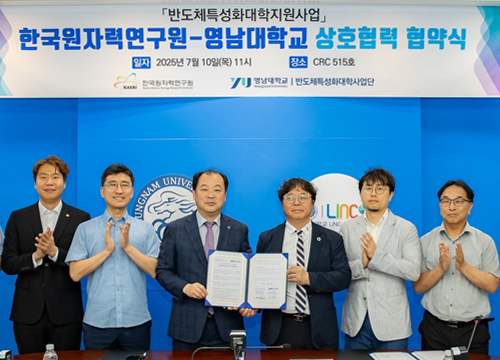
Establishing an advanced semiconductor education base through regional industry-academia-research collaboration Joint research and education programs using proton/ion beams to be actively pursued Regional industry expected to benefit from practical talent development and technological cooperation [July 25, 2025] <YU and the Proton Engineering Frontier Project of the Korea Atomic Energy Research Institute signed an MoU to foster semiconductor professionals and establish an industry-academia-research collaboration system> Yeungnam University (President CHOI Oe-chool) and the Proton Engineering Frontier Project of the Korea Atomic Energy Research Institute (Director LEE Jae-sang) signed a memorandum of understanding (MoU) on July 10 at 11:00 a.m. in the CRC Building conference room at YU to foster semiconductor professionals and establish a cooperative framework among academia, industry, and research institutions. The signing ceremony was attended by Director LEE Jae-sang and members of the administrative support team from the Proton Engineering Frontier Project, as well as Director KIM Jong-su and representatives from YU’s Semiconductor Specialized University Project Group. Following the signing, both institutions engaged in presentations and discussions on potential areas for mutual collaboration. This agreement aims to promote mutual benefits and regional development by encouraging the exchange of knowledge, information, and human resources between the two organizations in response to rapid technological advancements and the information age. Under the agreement, the two parties will collaborate in the following areas: ▲ Joint efforts to promote the semiconductor industry and industry-academia-research cooperation ▲ Consultation and collaboration for training semiconductor professionals ▲ Support for site visits, hands-on training, and talent matching ▲ Joint research infrastructure and R&D for mutual growth ▲ Technical support and business consulting for field-level challenges Notably, this agreement lays the groundwork for implementing specialized semiconductor education by combining the Korea Atomic Energy Research Institute’s expertise in proton/ion beam technology with YU’s semiconductor-focused educational infrastructure. Moving forward, the two institutions plan to introduce and jointly utilize semiconductor ion implantation equipment and operate collaborative educational programs to cultivate practical talent and enhance the semiconductor industry's competitiveness in the region. Director KIM Jong-su of YU’s Semiconductor Specialized University Project Group stated, “This agreement allows us to go beyond theory-based education and establish a practical, industry-grounded semiconductor training system.” He added, “We will continue to strengthen collaboration among academia, industry, and research institutions in the region to nurture globally competitive semiconductor professionals.”
- PR team
- 2025. 07. 23
- 2025. 07. 25
- 21253
-
YU’s Core Support Center for Natural Product-Based Medical Materials selected for follow-up project in the Basic Science Research Capacity Enhancement Program KRW 1 billion project over 3 years, including KRW 800 million in government funding, expected to boost competitiveness in bio and medical research Plans to upgrade research infrastructure and establish an independent operational foundation [July 16, 2025] Yeungnam University (President CHOI Oe-chool)’s Core Support Center for Natural Product-Based Medical Materials (Director NAM Joo-won) has been selected for the follow-up project under the “Basic Science Research Capacity Enhancement Program” administered by the Ministry of Education and the National Research Foundation of Korea. Through this follow-up project, the center aims to upgrade its research equipment operation system to improve research efficiency and transition to a sustainable, long-term operational model. The project will be carried out over the next three years with a total budget of KRW 1 billion, including KRW 800 million in government funding. Since first being selected for the program in 2019, Yeungnam University has systematically expanded its research foundation in the fields of natural products and medical materials over the past six years. The university has provided specialized research support, promoted joint equipment utilization, trained expert personnel, and built robust industry-academia collaboration networks. Building on these accomplishments, this follow-up project marks a key phase in strengthening the center’s operational stability and securing future growth. It focuses on modernizing and consolidating the research infrastructure. In particular, the center plans to enhance operational efficiency, improve its maintenance and management systems, and establish a revenue model based on research equipment services. These efforts aim to improve the center’s financial structure and create a more flexible system that can effectively respond to external demand. Director NAM Joo-won (Professor, College of Pharmacy) stated, “Being selected for this follow-up project enables us to further advance our research infrastructure and strengthen our capabilities for independent operation.” He added, “We will continue to enhance the professionalism and practicality of research on natural product-based medical materials to make a meaningful contribution to the development of the bio and pharmaceutical sectors.” Through this project, YU plans not only to establish a fully independent operational system for the center but also to expand its research scope through global joint research and technology commercialization. The university also intends to play an active role in building an innovative ecosystem for the regional bio industry.
- PR team
- 2025. 07. 23
- 2025. 07. 16
- 18930
-
Joint special exhibition by 10 university museums in the Yeongnam region runs from July 11 to October 24 Showcasing five years of outcomes from the Cultural Heritage Administration’s “Preservation and Utilization of Unorganized Buried Cultural Heritage” project From Gilt-Bronze Crowns to Gilt-Bronze Shoes—Reliving the Emotion of Excavation Sites [July 15, 2025] After a long period of dormancy in university museum storage rooms, precious artifacts are finally being unveiled to the public. On July 11, Yeungnam University (President CHOI Oe-chool) launched the special joint exhibition “After a Long Wait, Emerging from the Storage Room” in collaboration with ten university museums from the Yeongnam region. Buried cultural heritage excavated before the 2000s had long remained in storage at university museums, with few opportunities to be recognized for their academic and cultural value. However, from 2020 to 2024, under the Cultural Heritage Administration’s project “Preservation and Utilization of Unorganized Buried Cultural Heritage,” university museums were able to systematically organize their collections and perform professional preservation work.This special exhibition marks the first public unveiling of major artifacts from Silla and Gaya tombs, carefully selected over the past five years by the ten participating university museums, making the event all the more significant. Highlights include artifacts from the Goryeong Jisan-dong Tomb No. 45, the first Daegaya tomb ever excavated (Keimyung University Hengso Museum), and the Hwangodong Site No. 100 in Gyeongju, the burial place of a high-ranking Silla official uncovered in the heart of the city (Dongguk University WISE Campus Museum). Visitors can also view relics from the mural tombs of Sunheung in Yeongju (Daegu University Central Museum), which demonstrate cultural exchange among the Three Kingdoms. Additional highlights include discoveries from the Okjeon tombs in Hapcheon—known as the “Seventh Gaya” (Gyeongsang National University Museum); the Bokcheon-dong Tombs in Busan, which illustrate the rise of Gaya culture and its incorporation into Silla (Pusan National University Museum); and the Songhak-dong Tombs in Goseong, once a maritime trade hub (Dong-A University Seokdang Museum). Also on display are artifacts from the Hwangodong tombs in Gyeongju, excavated more than 60 years ago (Kyungpook National University Museum); the Gusandong tombs, representing post-Geumgwan Gaya culture (National Pukyong University Museum); and the Jungsan-ri Tombs in Ulsan, offering new insights into Silla burial customs (National Changwon University Museum). The exhibition also presents discoveries from the Imdang and Joyeong-dong tombs (Yeungnam University Museum), providing a comprehensive view of daily life during the Silla and Gaya periods. Beyond displaying artifacts, the exhibition sheds light on the historical narratives and aesthetic values behind each item. For example, the Imsin Seogiseok from Seokjang-dong in Gyeongju is an inscribed stone tablet reflecting the scholarly aspirations of Silla youth, offering a glimpse into educational culture. The plate armor from Dugok-ri in Gimhae represents the iron culture of Gaya and reveals the identity of ancient warriors. The pouch-shaped jar from the Yayoi-era ruins in Neukdo, Sacheon, reflects cultural exchanges between Korea and Japan. Other notable artifacts include gilt-bronze crowns, gilt-bronze shoes, tiger-patterned jars, cylindrical stands with figurines, petroglyph-style bronze daggers, and lute-shaped bronze daggers—all carefully selected to present a multidimensional view of ancient life, art, and interaction. Director LEE Eun-jung of the Yeungnam University Museum, who oversaw the planning of the exhibition, stated, “This exhibition is not just about putting artifacts on display. It’s an opportunity to reexamine the meaning of unorganized artifacts that have been largely unknown until now.” She added, “I hope this exhibition will allow visitors to rediscover the historical and cultural significance embedded in these objects.” Hosted by the Cultural Heritage Administration and organized by the Korean University Museum Association, this special exhibition is being held at the Yeungnam University Museum from July 11 to October 24. It is open to the public free of charge on weekdays and Saturdays from 10:00 AM to 5:00 PM. For group tours, please contact the YU Museum’s curatorial team at 053-810-1707.
- PR team
- 2025. 07. 23
- 2025. 07. 15
- 19479
-
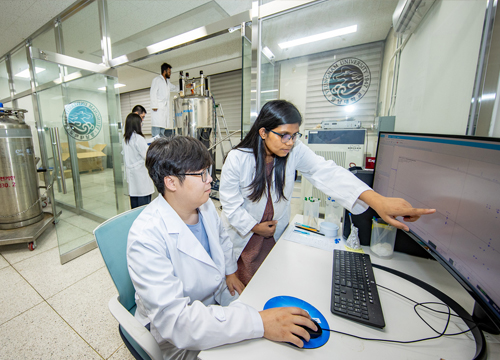
Yeungnam University (President CHOI Oe-chool) is accelerating its efforts to cultivate semiconductor specialists through its Semiconductor Specialized University Project Group. By building hands-on, industry-aligned education infrastructure and offering company-tailored curricula, YU is producing talent equipped to meet the demands of the semiconductor field. YU actively supports the government’s national policy to train semiconductor professionals in the era of AI and the Fourth Industrial Revolution. The university has established practice-oriented education systems connected to local ICT industries, the future mobility sector, and the regional semiconductor-specialized zone. It is focusing on developing demand-responsive programs to strengthen Korea’s semiconductor competitiveness by training talent specialized in materials, components, equipment, devices, and fabrication processes. At the heart of this effort is the Center for Advanced Semiconductor Component Technology (CASCT), which provides access to an in-house fabrication (FAB) facility. Leveraging this infrastructure, YU offers specialized education on next-generation power semiconductors and sensor devices based on wide-bandgap (WBG) semiconductors and III-V compound semiconductors—technologies that outperform traditional silicon in functionality and performance for applications such as power semiconductors, sensors, and quantum devices. Furthermore, YU has adopted an industry-academia cooperation model in which companies actively participate in both curriculum development and program operation. This strengthens the foundation for producing work-ready graduates and reinforces the university’s collaborative ties with industry. To encourage broader student participation, YU implements a flexible, department-neutral recruitment process that enables students from a variety of majors to join the semiconductor training program. Currently, nine departments are involved in the initiative, with approximately 30 full-time faculty members dedicated to delivering expert instruction. Beginning with an annual output of 120 trained professionals in 2025, YU plans to expand the program to cultivate 200 graduates per year by 2027. In addition, the CASCT serves as the core of several semiconductor-related talent development and research initiatives, including the Regional University Revitalization Project, the Gyeongbuk Semiconductor Super-Gap Talent Development Project, the Gyeongsan Education Advancement Special Zone Project, and the National Research Foundation's Nano Material Technology Development Program. YU is playing a critical role in producing the skilled workforce needed by both the region and the nation. YU also takes on the role of a "Semiconductor Academy" for Gyeongbuk Province by providing semiconductor education to elementary, middle, and high school students, thereby promoting the spread of semiconductor education among future generations. President CHOI Oe-chool of Yeungnam University stated, “The key to success in the semiconductor industry lies in securing outstanding talent. YU will become a core hub for next-generation semiconductor research and education.” He added, “Building on this achievement, we will continue to expand our role as a university that cultivates top-tier professionals aligned with the needs of the Fourth Industrial Revolution and the local industries.”
- PR team
- 2025. 07. 10
- 2025. 06. 27
- 22725
-
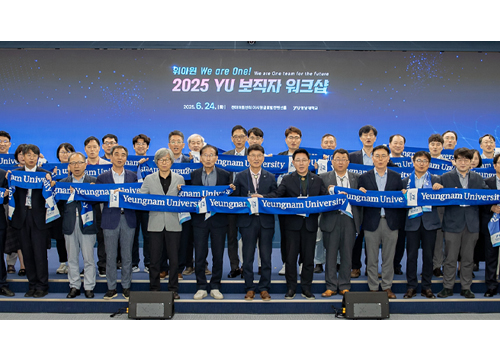
Over 60 key administrators from the university, medical center, and research foundation gather to discuss development plans and organizational innovation Open discussions and networking strengthen collaboration in management, organization, and industry-academia cooperation University development plan shared; workshop concludes with special lecture by President CHOI Oe-chool [June 26, 2025] Yeungnam University (President CHOI Oe-chool) held the 2025 YU Executive Workshop on June 24 at the Cheonma Art Center. Under the theme “We are One! – We are One Team for the Future,” the event brought together more than 60 administrators from the university headquarters, the Industry-Academic Cooperation Foundation, and Yeungnam University Medical Center. The workshop served as a platform for sharing university development strategies and fostering collaboration and innovation across organizational units. The workshop featured a keynote lecture by an external expert, presentations of development plans by key departments, and breakout sessions with group discussions followed by a results-sharing session. The morning session included a keynote lecture by CTO LEE Jin-won of HyperExcel on the topic “AI and University Innovation.” This was followed by development plan presentations from LEE Hee-Yong, Director of Planning and Coordination; KIM Jong-Soo, Director of the Industry-Academic Cooperation Foundation; and SEO Wan-Seok, Director of Planning and Coordination at the medical center—each outlining their visions for the university, industry-academic collaboration, and healthcare sectors. In the breakout discussions, participants were divided into three groups—Educational Innovation, Administrative Innovation, and Industry-Academic/Research Innovation—each chaired by a vice president. The groups discussed current issues and proposed practical solutions. The sessions fostered open dialogue and led to actionable ideas, which were then shared in the afternoon session. <President CHOI Oe-chool delivers a keynote lecture at the 2025 YU Executive Workshop.> The workshop concluded with a keynote address by President CHOI Oe-chool, who shared his core leadership philosophy: “Driving innovation through policy consistency and securing the university’s sustainability.” He emphasized a results-driven approach to implementing strategic initiatives and laid out his vision for transformative progress. More than a simple strategy-sharing session, the event was recognized for breaking down silos between the university, its medical center, and its industry-academic foundation. It reinforced the importance of unity and integration. The day also included a campus and museum tour, a dinner reception, and a celebratory performance, all of which contributed to strengthening bonds among participants. In a particularly meaningful gesture before the main event, coffee trucks were dispatched to the Industry-Academic Cooperation Foundation and the medical center to express appreciation for their dedicated service. This thoughtful pre-event shared the workshop’s spirit of “One Team” in advance, recognizing those who work tirelessly for the university and hospital. President CHOI stated, “This workshop marks a new beginning for the university headquarters, medical center, and industry-academic foundation as one unified team pursuing a common goal.” He continued, “Communication and collaboration among organizations are the most powerful driving forces behind university development. They enable us to build a culture of strong execution and flexible innovation.” He concluded, “Yeungnam University will continue to grow as a community where every member thrives together. We are committed to cultivating talent that not only contributes to elevating Korea to a refined and advanced society but also serves humanity on a global scale—founded on innovation, unity, and shared responsibility.”
- PR team
- 2025. 07. 10
- 2025. 06. 26
- 22730